Click on Image for Enlarged View & Click Back Arrow to Return
The Family Room Operating Position
Updated 13-May-2026
|
I have one fixed
operating position that is not located in my basement
"shack". This is in my family room and it
is housed around what was once a computer
desk. Over the years both my wife and I have
gone to laptops for our computing needs around
the house and access the internet via WiFi
connection. The only desktop or work station
computers I now use are in my basement radio shack and
in my lab area. The computer that was occupying
this desk saw very little use and as a result the desk
became a resting place for other junk
items. After performing upgrades to my
Drake TR7 HF transceiver I decided to utilize this old
computer desk as a new operating position.
The computer desk was much to nice to relegate as a
unused area for junk collecting.
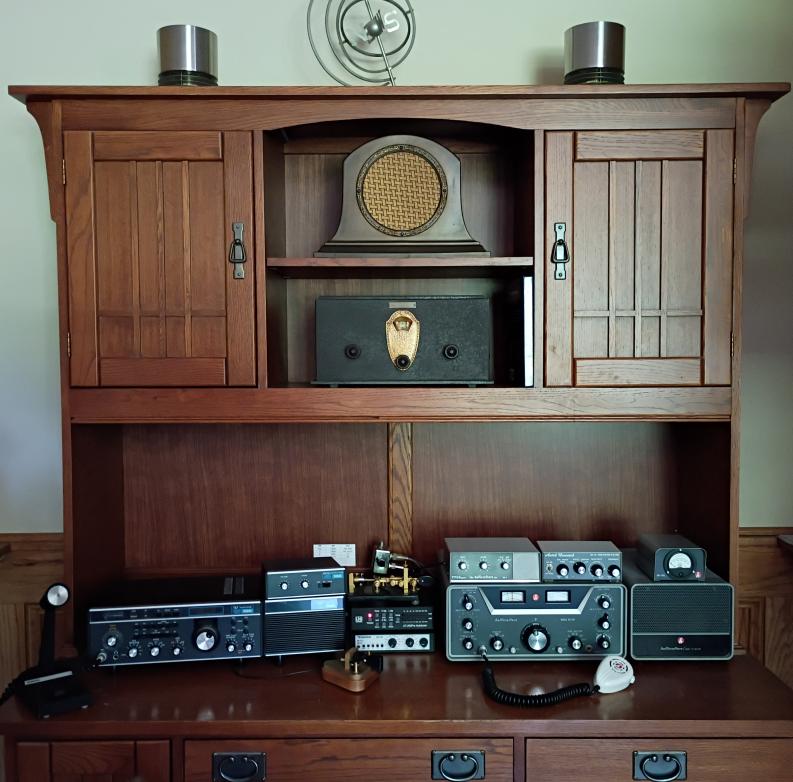
The station consists of a Drake TR7 HF transceiver with matching MS-7 Speaker (circa 1980) with extensive modification added to the rig. The original transmit/receive SSB crystal filter was changed from the original 2.3KHz BW to a new Sherwood Engineering 2.85KHz BW Enhanced SSB filter. The SSB carrier offset adjustments were changed, from those indicated in the service manual, to take advantage of the wider audio passband presented by the new filter. All the remaining receive mode filters are also installed for CW, Narrow SSB and AM. In addition a multicolor frequency display, blue LED back lighting, fully populated AUX-7 unit and the X-Lock frequency stabilizer were installed. The X-Lock operation status LED was added to a newly created reverse scaled back-lit meter. Circuit modifications were performed to improve the receive audio and finally multi-turn potentiometers replacements have been added to the power supply board for enhanced alignment stability. In August of 2025, I added the Drake CW75 Electronic Keyer to my 7-Line. It is directly above the MS7 Speaker. Produced over the same early 1980's time frame as the rest of the TR7 line-up, it probably didn't sell in large quantity. It uses four 14000 series Motorola CMOS IC's. Per the specs it can do 5-50 WPM. The internal audio is a bit harsh as it is derived from a square wave oscillator circuit and the only waveform modification is the inductance of the speaker along with a capacitor across those same terminals. The TR7 itself has a very clean internal sine wave sidetone and thus I use that, keeping the CW75 volume control at the minimum (OFF) setting. I've always enjoyed CW since my Novice days in 1971, so this was a chance to return to my roots. The paddle is an original Vibroplex Brass Racer Iambic paddle. 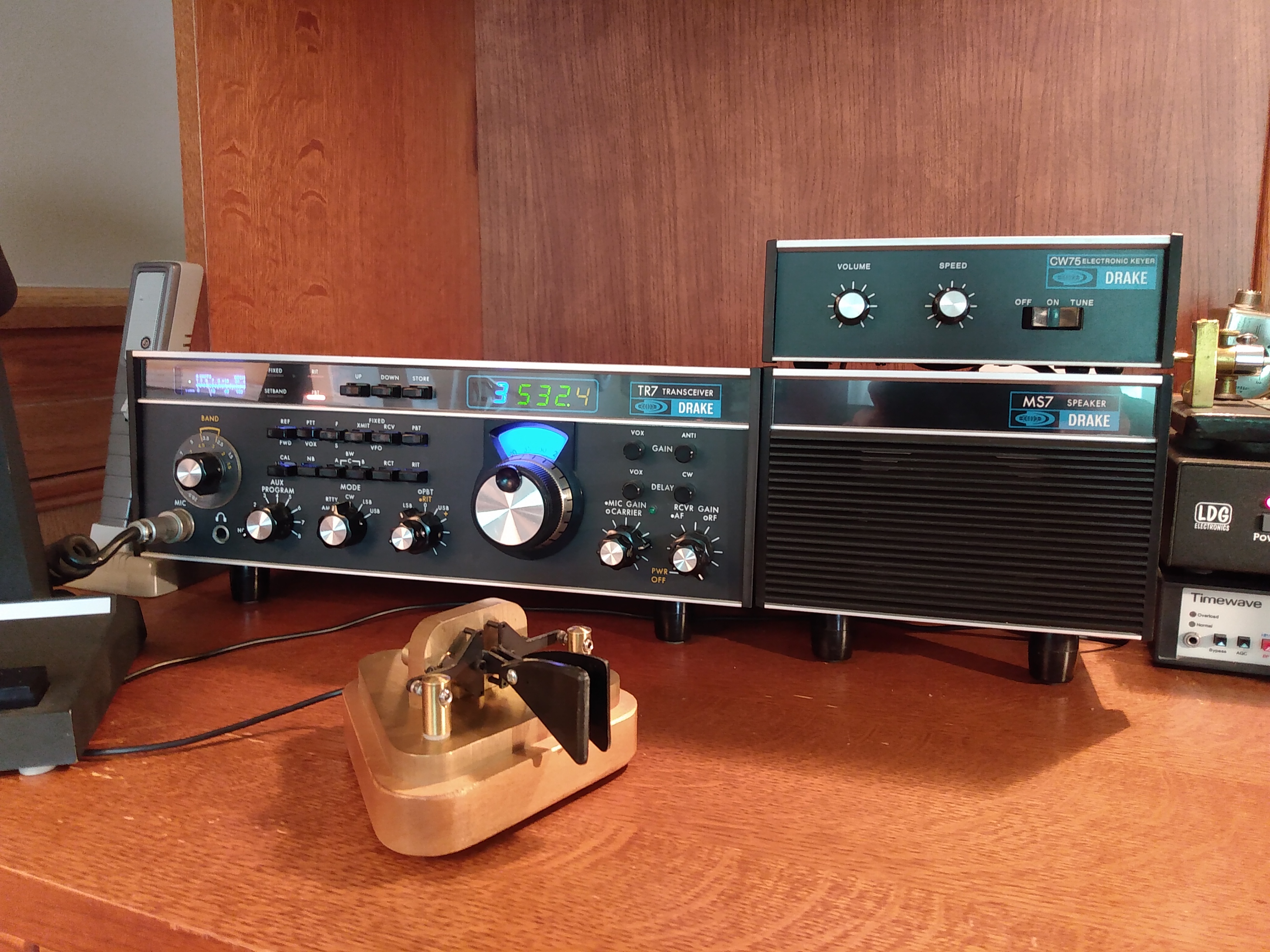 A Closeup of the
Drake TR7
Click on Image for Enlarged View & Click Back Arrow to Return On the right side of the desk is the Hallicrafters SR-150, 80-10M SSB/CW transceiver, with its matching SP-150 PS/Speaker (circa 1962). The power supply was recapped (2025) and few parts replaced in the transceiver. I am only the second owner of this transceiver! On top the transceiver (left) is the rare Hallicrafters HA-4 T.T.O. Keyer. This solid-state, using period germanium transistors, CW Keyer was only sold for one year starting mid-1961 and then being pulled from their product line by mid-1962. Very few of these appear to remain in the wild. Hallicrafters did make the vacuum tube HA-1 Keyer, the T.O. Keyer, starting a year before the HA-4. The HA-1 was still being sold by them ten years later in 1970. Directly to the right of the HA-4 is a Autek Research QF-1A Active Audio Filter, which is used primarily for CW operations. This later filter is in-line with the speaker inside the SP-150 Power Supply. On top of the SP-150 power supply (PS) is a home made Plate Current Meter for the SR-150. The SR-150, along with other Hallicrafters transceivers that use the aforementioned PS do not have integrated plate current meters. Instead this series of transceivers used a relative power output meter. The later made for very easy transmitter tuning, as you only tune all the appropriate controls for a maximum meter deflection. However, plate idle current is also very important in the final amplifier tubes, as is a true match of maximum power and the corresponding dip in the output tubes plate current. The SP-150 power supply offered a small internal resistance (10 ohms) in series with the final amplifier tubes high voltage line. That allowed for monitoring the DC voltage across it using an external high impedance voltmeter and a simple conversion to provide the actual plate current value. In my case, I made a slight change and put a 500uA DC current meter in series with around a 10K ohm variable resistance across that power supply resistor. I adjust the resistance to provide a divide by 1000 of the actual value of plate current. So my 0-500µA meter becomes a makeshift 0-500mA plate current meter. A real one-to-one reading if you just realize the multiplier. I simply added a decal on the meter face that states X1000. 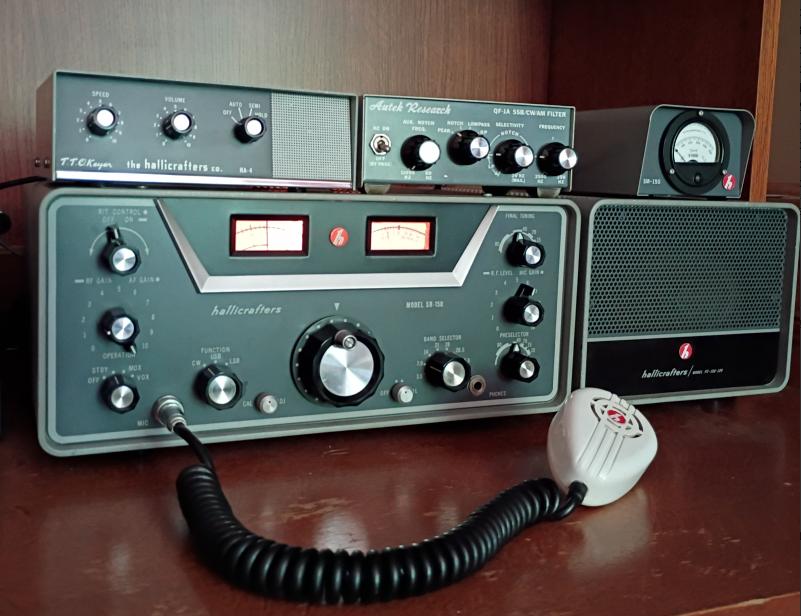 A Closeup of the
Hallicrafters SR-150 Setup
Click on Image for Enlarged View & Click Back Arrow to Return 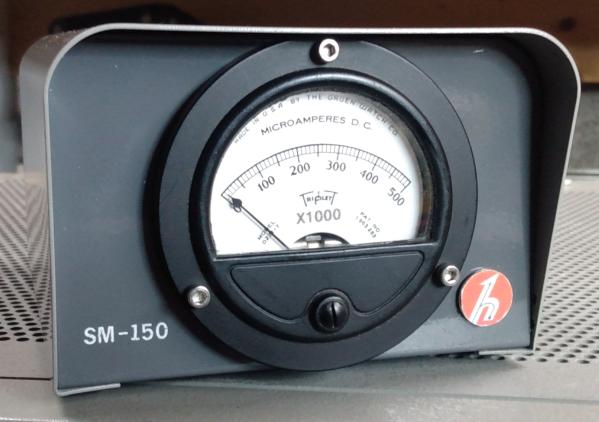 A Closeup of the Hallicrafters SM-150 (My ID) Homebrew External Plate Current Meter Click on Image for Enlarged View & Click Back Arrow to Return Opening the doors on the lower front of the desk reveals the TR7's PS-7 12V Power Supply and a few other station accessories. Notice the AC distribution switch panel is also behind this door. What was once a hidden flip down computer keyboard shelf now houses a 2M FM transciever, a Wilson WE-800. The WE-800 was made in Japan for Wilson and provided 12W output, but also contained an internal battery pack allowing for low power portable 1W operation (batteries are removed). This is a fully 144-148MHz synthesized radio that saw limited sales success. New price 1977 in the US: $399.00. I added a PL Deck to the WE-800 in early 2025 and that was not an easy task! No service manual exists for this transceiver, but luckily a schematic was in the standard operation manual. It required a great deal of reverse engineering analysis to match the schematic to the various PCB's inside the radio. It was not an easy adventure. 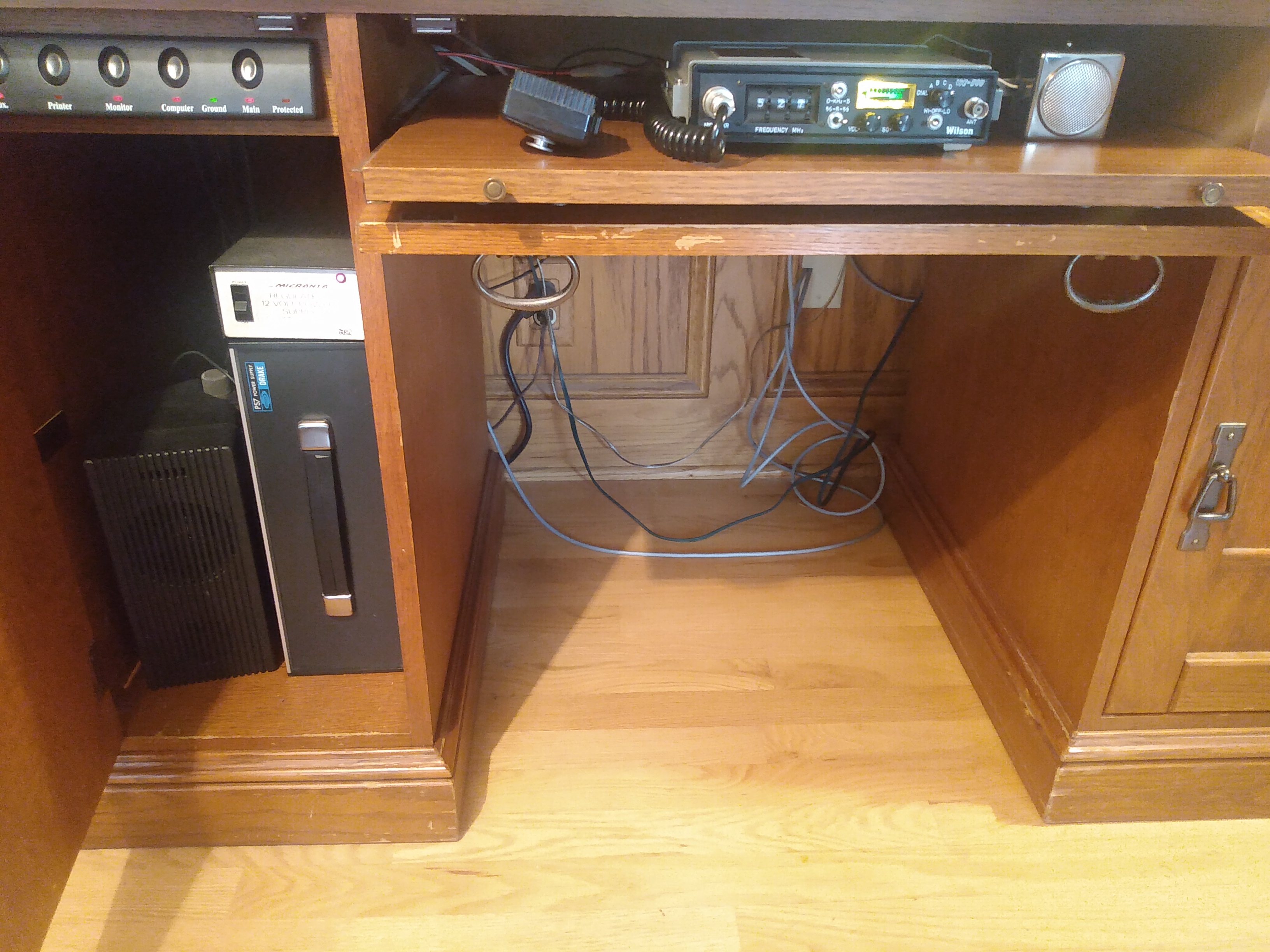 Closeup of what's
behind the doors
The remaining desk items consist of an LDG AT-200Pro
Autotuner, used for both rigs, and the Timewave DSP-59+
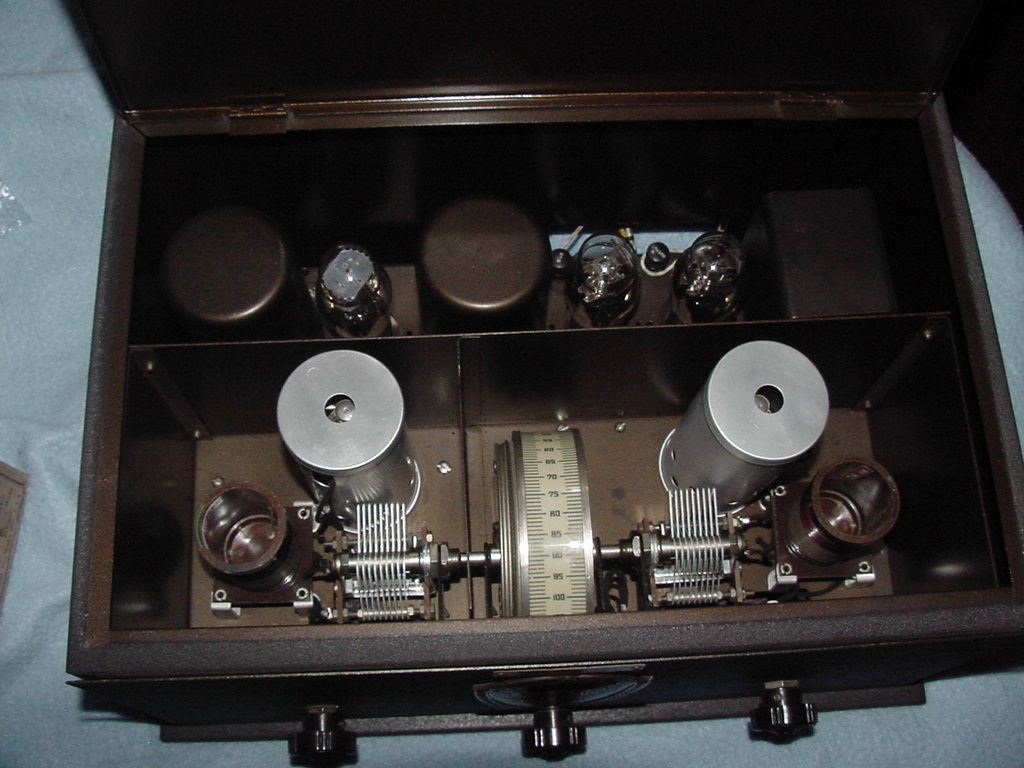
Audio DSP on the TR7 only. Click on Image for Enlarged View & Click Back Arrow to Return Above the operating table, on the top shelves, are two items from my vintage radio collection. The lower item is a Lafayette "Wideworld Receiver", A.K.A. a National SW-5 variant ( circa 1930) and above that the RCA 100A speaker. Both of these are fully operational! Click HERE to look inside my Lafayette Wideworld Receiver. Ain't it a stunning restoration for something that is almost 100 years old! |
 Back to my homepage